
Light Requirements
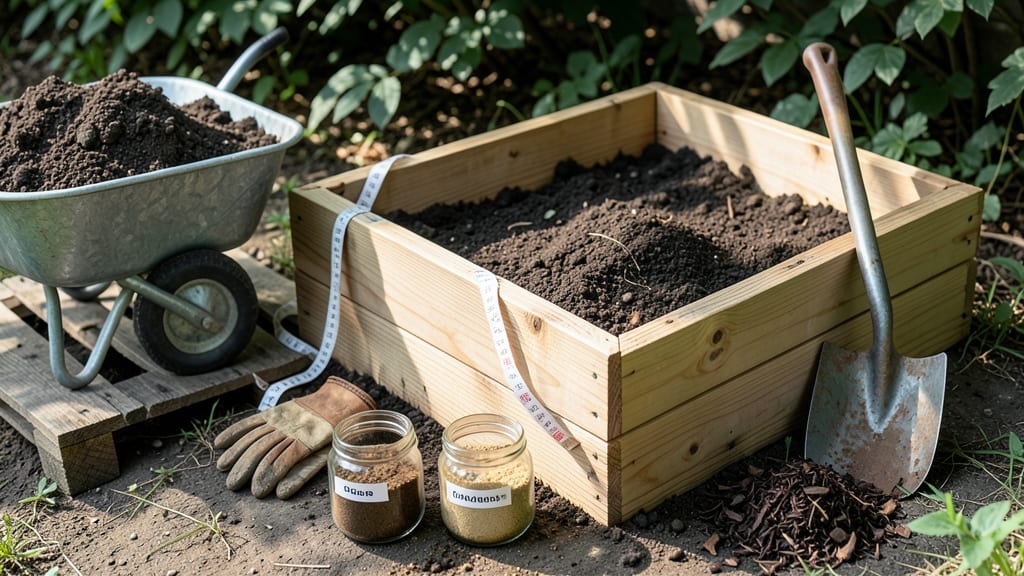
To determine how much soil for a raised garden bed, multiply the bed's length by width by depth (in feet), then account for settling—loose soil typically compresses to about 80% of its original volume. A standard 4’x8’ bed filled to 12” depth requires roughly 32 cubic feet of soil before tiling.
This calculation ensures you buy enough soil to fill the bed completely after settling, which can vary based on soil type. 🌱 For example, a 6” deep bed of the same dimensions would need about 16 cubic feet, while deeper beds (18”+) may require 48 cubic feet or more.
Always check your soil's compaction rate—bagged mixes often settle differently than loose topsoil.
Pro tip: Buy 10-15% extra to account for uneven settling or future top-ups. Most garden centers sell soil by the cubic yard (27 cubic feet), so rounding up to the nearest full yard simplifies shopping.
For instance, a 4’x8’x12” bed would need just over 1 cubic yard, making a 1.25-yard bag the practical choice.
💡 In This Article
- Raised Bed Soil Volume Formula: Depth and Compaction Explained
- Best Soil Mix for Raised Garden Beds: Quantity and Blend Tips
Raised bed soil volume formula: depth and compaction explained
Here's what's actually happening when you calculate soil volume: the formula length × width × depth gives you the raw cubic footage, but real-world conditions change this number. Loose soil—whether bagged or bulk—settles as you till it because air pockets collapse and particles rearrange.
For most garden soils, this settling factor is about 20%, meaning 1 cubic foot of loose soil becomes roughly 0.8 cubic feet after tiling. This is why your calculations must account for this compression, especially in deeper beds where settling can be more pronounced.
The depth of your raised bed dramatically changes the total soil volume needed. A 6-inch deep bed (0.5 feet) will require significantly less soil than a 12-inch or 18-inch bed.
For example, a 4’x8’ bed at 6” depth needs only 16 cubic feet of loose soil, while the same bed at 12” depth jumps to 32 cubic feet. The deeper the bed, the more pronounced the compaction effect becomes, as heavier layers compress more under their own weight.
Organic matter in the soil also plays a role—compost-rich mixes settle more dramatically than pure topsoil because the organic material breaks down and compacts further over time.
What this means for you is that buying soil by the cubic yard (27 cubic feet) is practical, but you'll need to do some quick math.
A 4’x8’x12” bed requires just over 1 cubic yard of loose soil, so rounding up to a 1.25-yard bag ensures you have enough after settling. For deeper beds (18”+), you might need 1.5–2 cubic yards of soil.
Always check the settling rate of your specific soil mix—bagged blends often have different compaction characteristics than loose topsoil, and some premium mixes are pre-composted to minimize settling.
There are exceptions to this rule, particularly with heavy or clay-based soils. These types compress less dramatically but may require additional amendments (like perlite or sand) to improve drainage. Sandy soils, on the other hand, settle less but drain too quickly unless mixed with organic matter.
The key is to test your soil's compaction rate: fill a small container with the soil you plan to use, till it, and measure how much volume is lost. This hands-on approach ensures your calculations are tailored to your specific materials.
Consider this real-world example: if you're using a pre-mixed raised bed soil blend (often sold in bags labeled "raised bed mix"), these are typically formulated to settle less—sometimes as little as 10%. In this case, your calculations can be slightly more generous.
However, if you're mixing your own soil with topsoil, compost, and perlite, expect a higher settling rate closer to 20–25%. Always err on the side of buying a little extra, as uneven settling or future top-ups (like adding compost annually) can deplete your initial volume over time.
One nuance to keep in mind is the role of moisture. Wet soil compresses more than dry soil, so if you're filling your bed in rainy conditions, you may need to adjust your volume slightly upward.
Conversely, bone-dry soil can resist compaction initially but will settle more as it absorbs moisture. To mitigate this, consider filling your bed in dry conditions and watering it lightly before final tiling to encourage even settling.
Here’s a quick reference for common bed sizes and their soil needs (pre-settling):
- 4’x8’x6”: ~16 cubic feet (0.6 cubic yards)
- 4’x8’x12”: ~32 cubic feet (1.2 cubic yards)
- 4’x8’x18”: ~48 cubic feet (1.8 cubic yards)
- 8’x8’x12”: ~64 cubic feet (2.4 cubic yards)
With these numbers, you’ll avoid the frustration of running short mid-project—and end up with a perfectly filled, fertile raised bed ready for planting! 🌱