
Landscaping
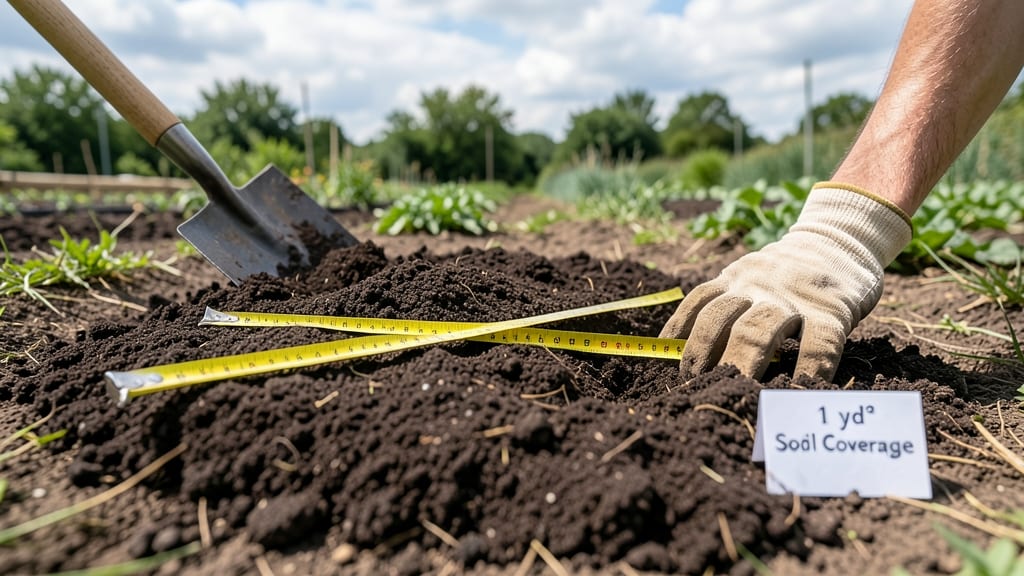
Calculating yard of soil coverage shows that one cubic yard spreads over 9 square feet at 3 inches deep or covers 27 square feet at just 1 inch thick. This conversion helps landscapers and gardeners estimate bulk soil needs accurately for projects.
Understanding this conversion prevents common mistakes like buying too much or too little soil.
For example, a 100-square-foot garden needing 3 inches of topsoil would require about 3.7 cubic yards (100 ÷ 9). 🌱 Many people forget that soil settles over time, so adding 10-20% extra is wise for long-term projects.
The math becomes even more critical for raised beds, where depth affects plant root development.
When planning larger projects like lawn topsoil or erosion control, consider soil type too—sandy soil compacts differently than clay. A 1-foot layer of mulch or compost will need more cubic yards than the same area covered with just 1 inch of topsoil.
Always verify depth requirements with your project's specific goals, whether it's vegetable gardens or landscape leveling.
💡 In This Article
- Understanding Soil Volume and Depth Calculations
- Practical Soil Coverage Tips for Landscaping Projects
Understanding soil volume and depth calculations
A cubic yard of soil measures 3 feet long × 3 feet wide × 3 feet deep, containing exactly 27 cubic feet of material.
This volume converts to coverage based on depth—1 cubic yard covers 9 square feet at 3 inches deep (a common depth for seed germination) or 27 square feet at just 1 inch thick.
The math works because 27 cubic feet ÷ 3 inches = 9 square feet, while 27 cubic feet ÷ 12 inches = 2.25 cubic feet per square foot, meaning 1 cubic yard covers 27 square feet at 1-inch thickness.
Visualize this with a 10-foot-by-10-foot garden plot (100 square feet). At 3 inches deep, you'd need 100 ÷ 9 ≈ 11.1 cubic yards. For a 1-foot-deep raised bed, the same plot requires 100 ÷ 27 ≈ 3.7 cubic yards.
This shows why depth dramatically impacts material needs—doubling depth from 3 inches to 6 inches would require twice the soil volume for the same area. 🌱
Soil compaction changes the equation. Loose, fluffy compost settles over time, reducing effective volume by 10-20%. For example, a 1-yard bag of potting mix may only cover 12-15 square feet when settled at 3 inches deep, not the theoretical 9 square feet.
Clay-heavy soils compact even more, while sandy soils retain their volume better. Always account for this "settling factor" when estimating bulk orders.
Consider project-specific needs: A vegetable garden typically requires 6-12 inches of loose, nutrient-rich soil, while a lawn topsoil application might only need 2-3 inches. For erosion control, 4-6 inches of stabilized soil is standard.
The key is matching soil depth to root zone requirements—shallow-rooted plants like lettuce need 6 inches, while deep-rooted perennials may require 18 inches.
For visual reference, imagine stacking three 3-foot-by-3-foot pallets (each representing 1 cubic yard). The bottom pallet covers 9 square feet at 3 inches, the middle at 6 inches, and the top at 9 inches. This stacking method helps gardeners grasp how quickly soil volume adds up across larger areas. 💫
Professional landscapers use a simple formula: Area (sq ft) × Depth (inches) ÷ 324 = cubic yards needed. The number 324 comes from 3 feet × 3 feet × 36 inches (converting feet to inches).
For a 500-square-foot lawn needing 2 inches of topsoil: (500 × 2) ÷ 324 ≈ 3.1 cubic yards. This formula eliminates guesswork for precise ordering.