
Size
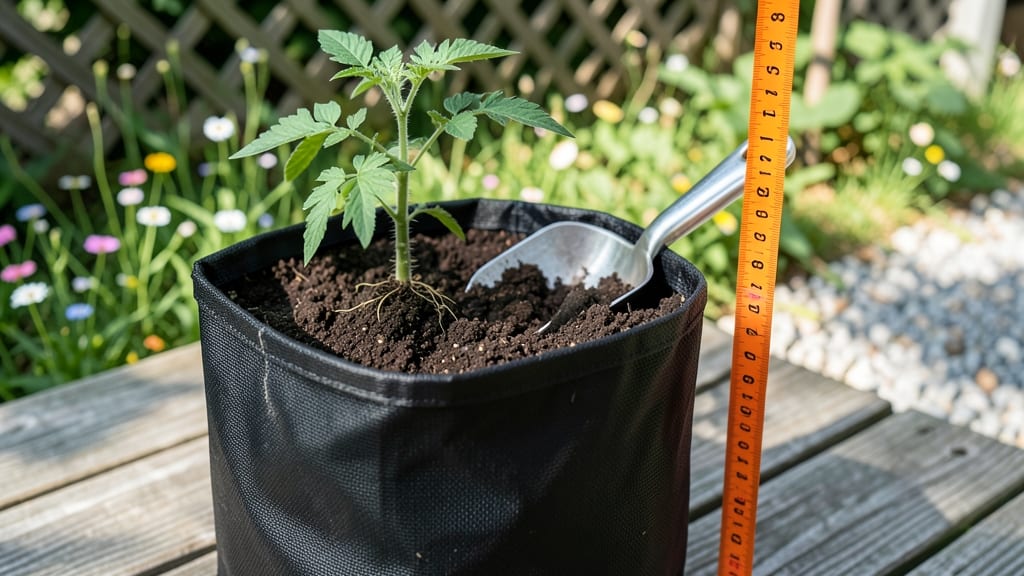
For a 15-gallon grow bag, you'll need 10–12 quarts (2.5–3 cubic feet) of soil when filled to a depth of 12–14 inches, allowing room for root expansion and proper drainage. Always use a well-draining potting mix blended with perlite or vermiculite.
A 15-gallon grow bag's capacity isn't just about volume—it's about balancing root space with drainage. 🌱 The 12–14-inch depth recommendation ensures plants like tomatoes or peppers have enough room to grow without becoming root-bound.
I've found that lighter mixes (like those with coconut coir) actually require slightly more volume because they settle less over time. For heavy feeders, consider adding a 2-inch drainage layer of gravel or expanded shale at the bottom to prevent compaction.
Another key factor is soil type: organic mixes (like 60% potting soil + 30% compost) hold moisture better but may need occasional fluffing, while mineral-heavy blends (with perlite) drain faster but require more frequent watering.
Always pre-moisten your soil before filling the bag to eliminate air pockets and ensure even moisture distribution.
💡 In This Article
- Calculating Soil Volume for 15-Gallon Grow Bags
- Best Soil Mixes and Layering for 15-Gallon Grow Bags
Calculating soil volume for 15-Gallon grow bags
Understanding how much soil fits in a 15-gallon grow bag starts with basic geometry. A standard grow bag typically measures about 12" wide × 24" long × 12-14" deep when filled.
Using the formula for rectangular volume (length × width × height), we calculate roughly 3.5 cubic feet of space—but this includes air gaps and drainage needs. The actual soil volume shrinks to 2.5-3 cubic feet (10-12 quarts) when accounting for proper depth and root expansion room. 🌱
The 12-14 inch depth recommendation isn't arbitrary—it balances root development with drainage. Shallow fills (<10 inches) restrict root growth, while overfilling (>16 inches) creates anaerobic pockets that suffocate roots.
For example, a tomato plant's root system can spread 12-18 inches wide and deep, so the 12-14 inch fill leaves room for lateral expansion while maintaining oxygen flow.
Soil type affects this too: Organic mixes (like peat-based blends) settle about 10-15% over time, requiring you to fill to the top initially, while mineral-heavy mixes (with perlite) may only settle 5-10%.
Here's how the math breaks down for different soil types:
- Standard potting mix: Fill to 13-14 inches (allows for ~10% settling)
- Compost-heavy blends: Fill to 14 inches (15-20% settling expected)
- Perlite/vermiculite mixes: Fill to 12 inches (minimal settling)
What most gardeners overlook is the weight factor. A cubic foot of standard potting mix weighs about 40-50 pounds—so your 15-gallon bag could hold 100-150 pounds of soil when full. This is why grow bags have reinforced bottoms: the weight increases dramatically as roots expand and soil compacts.
For comparison, a 5-gallon pot holds only 2-2.5 cubic feet of soil but weighs half as much due to shallower depth.
The quart measurement (10-12 quarts) comes from converting cubic feet to dry volume. One cubic foot equals 25.714 dry quarts, so our 2.5-3 cubic feet range translates neatly to the 10-12 quart guideline.
Pro tip: Use a measuring bucket (like those for concrete mixing) to accurately portion your soil—standard 5-gallon buckets hold about 10 quarts of loose potting mix, making them perfect for this application. 💫
One common mistake is assuming the gallon rating equals soil capacity. The "15-gallon" label refers to the bag's total volume when empty, but only 60-70% of that space should be filled with soil to prevent compaction. The remaining space allows for root expansion and water drainage.
For heavy plants like squash or melons, you might need to adjust to 14-16 inches of soil depth, but this requires monitoring water needs closely—these plants drink significantly more than tomatoes or herbs.