
Container Gardens
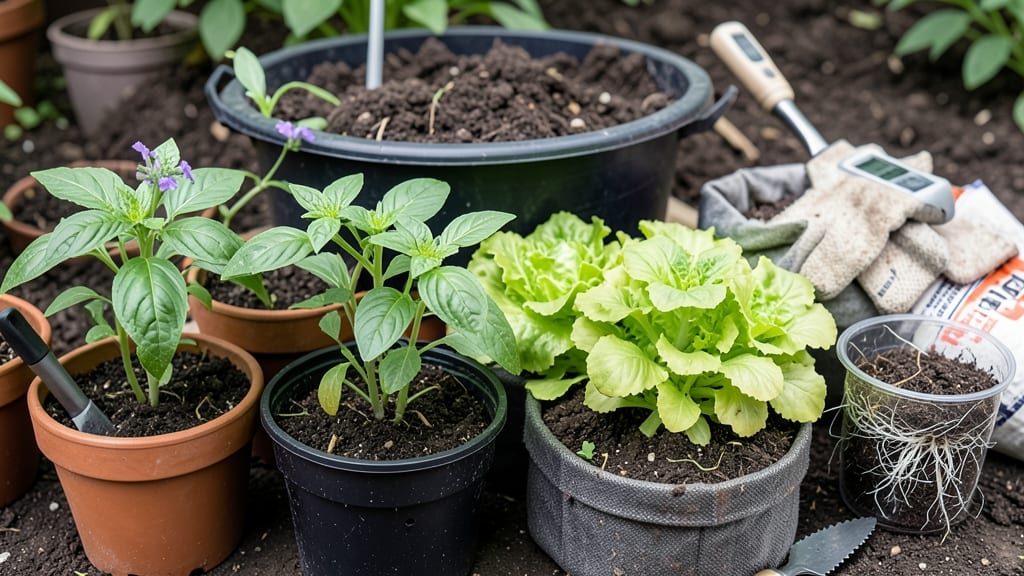
Using garden soil in containers harms plants by compacting roots, suffocating drainage, and inviting pests or diseases. Instead, blend it with perlite, compost, and coarse sand to improve aeration and nutrient flow while preventing root suffocation.
Garden soil's heavy clay and organic matter break down too quickly in containers, creating a dense, waterlogged mess that roots can't penetrate. 🌱 Unlike in-ground gardens where soil has room to expand, container plants need lightweight mixes that stay loose and well-draining.
I've seen firsthand how plants wilt within weeks when planted directly in garden soil—even with regular watering. The solution? Amending garden soil with 30% perlite or vermiculite creates air pockets, while compost adds nutrients without compacting.
The key is balance: too much perlite makes the mix too dry, while too much compost can compact over time. For herbs and vegetables, I recommend a 50-50 blend of garden soil and coconut coir with 20% perlite.
Succulents thrive in mixes with even more grit—up to 60% coarse sand—to prevent rot.
💡 In This Article
- Why Garden Soil Fails in Container Gardening
- Best Soil Mixes for Container Plants
Why garden soil fails in container gardening
Garden soil's natural composition makes it a poor fit for containers because its heavy clay particles and dense organic matter create a suffocating environment for roots.
When you pack garden soil into a pot, the clay particles compress tightly, reducing pore space by up to 70% compared to loose potting mixes.
This compression forces roots to compete for oxygen in microscopic air pockets, leading to stunted growth and increased susceptibility to root rot. 🌱 The problem worsens in small containers where water can't drain efficiently, creating a waterlogged scenario that mimics swamp conditions.
The organic matter in garden soil breaks down much faster in containers due to limited space and increased microbial activity. What takes years to decompose in open ground can become a compacted, nutrient-depleted mess within 3-6 months in a pot.
This rapid degradation leaves roots starved for oxygen and nutrients, while the remaining organic material turns into a gummy, anaerobic sludge that repels water instead of absorbing it. You'll often see plants in garden soil wilting despite regular watering because the soil's structure prevents proper moisture uptake.
Clay particles in garden soil also have a strong negative charge that attracts positively charged minerals like calcium and magnesium, locking them into forms plants can't access. This chemical binding creates nutrient imbalances where essential elements become temporarily unavailable, even if they're present in the soil.
The result? Yellowing leaves, weak stems, and poor flowering—symptoms that mimic nutrient deficiencies but are actually caused by poor soil structure. Unlike in-ground gardens where roots can spread freely, container plants have no escape from this compacted environment.
Another critical issue is pest and disease introduction. Garden soil often contains weed seeds, fungal spores, and soil-borne pathogens that thrive in the warm, moist conditions of containers. Unlike open ground where these organisms have natural predators, container ecosystems become breeding grounds for problems like powdery mildew, damping-off, and nematodes.
The confined space accelerates these issues, making prevention nearly impossible once established. 🌿 This is why professional growers avoid garden soil entirely for container cultivation.
Consider this comparison: a typical garden soil has a porosity (air space) of about 10-20%, while an ideal potting mix maintains 30-50% porosity. That extra air space is what allows roots to breathe and water to drain properly.
The difference is like trying to breathe through a straw versus open air—the roots simply can't function optimally in dense soil. This structural failure is why even experienced gardeners see container plants struggle when planted directly in garden soil.
The science behind this involves soil physics and chemistry working against container gardening. Clay particles have a high surface area that attracts water molecules through hydrogen bonding, creating a hydrophobic layer that repels additional moisture.
This is why garden soil often feels dry on top but remains waterlogged below—water can't penetrate the compacted layers. In containers, this creates a cycle where water pools at the bottom while the upper soil remains bone-dry, stressing plants between overwatering and underwatering extremes.