
How To
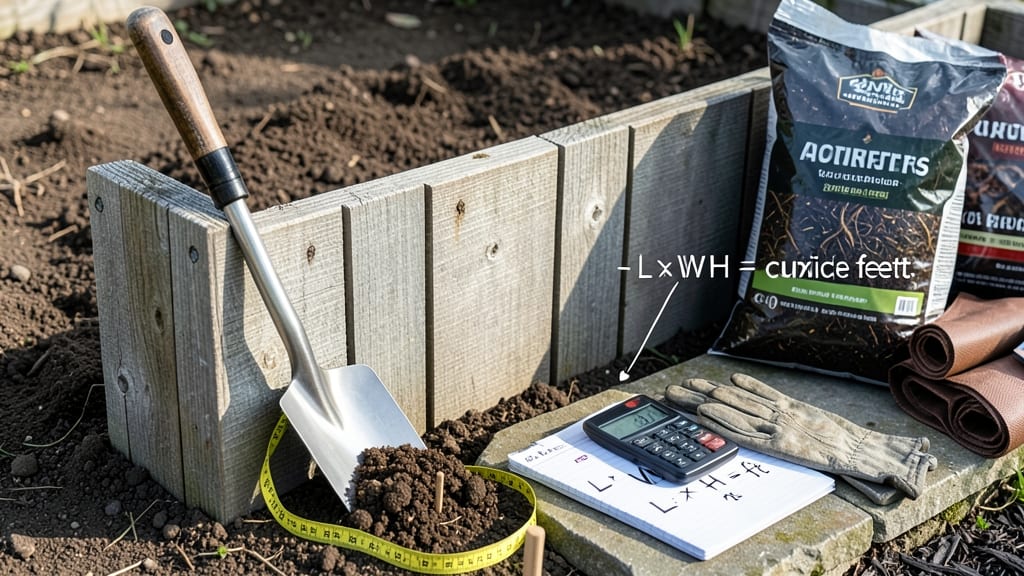
Calculating soil for raised beds saves you from hauling bags home only to realize you’re short—or drowning in leftover soil you’ll never use. I’ve filled enough beds to know the math behind perfect planting starts with three simple numbers: length, width, and depth.
Skip the guesswork, and you’ll walk away with exactly what your garden needs, no more, no less.
Here’s the trick: multiply your bed’s length by width to get the square footage, then multiply that by the depth (usually 6–12 inches for most veggies) to find cubic feet. Convert to cubic yards by dividing by 27—one cubic yard covers about 108 square feet at 6 inches deep.
Pro tip: round up for compost or mix additions, but never down. That extra bag could mean the difference between thriving plants and struggling ones.
You’ll end up with a soil blend tailored to your plants—light and fluffy for root crops, rich and moist for leafy greens—all while avoiding the heartbreak of running out mid-project. My first raised bed was a disaster because I eyeballed it; now, I measure twice and fill once.
The payoff? A garden that looks like it belongs in a catalog, not a backyard.
Works for any bed shape or size, from 4x8-foot classics to custom curves. Grab a tape measure, a calculator, and let’s get growing—without the stress of last-minute trips to the garden center.
📚 In This Guide
- What you need
- Instructions
- Tips and common mistakes
- Wrapping up and next steps
What you need
- ● Topsoil: 60-80% of your mix (e.g., 4-5 cubic feet per square foot of bed depth). Opt for organic, well-draining topsoil with a pH of 6.0-7.0.
- ● Compost: 20-30% of the mix (e.g., 1-2 cubic feet per square foot). Use finished, mature compost (avoid fresh manure).
- ● Perlite or Vermiculite: 5-10% of the mix (e.g., ½ cubic foot per square foot). Improves aeration and drainage.
- ○ Sand (optional but helpful): 5-10% for heavy clay soils (e.g., ½ cubic foot per square foot). Use coarse horticultural sand.
- ● Slow-release fertilizer: 1-2 cups per 10 sq. ft. (e.g., 10-10-10 or organic options).
- ● Wooden boards or cinder blocks: For framing your raised bed (if not pre-built). Use rot-resistant wood like cedar or redwood (2x6 or 2x8, 8-12 ft long).
- ● Measuring tape (for bed dimensions).
- ● Wheelbarrow or large bucket (for mixing soil).
- ● Garden shovel or spade (for layering and turning soil).
- ● Gloves and dust mask (for protection).
- ○ Soil pH test kit (optional but recommended).
- ● Level or string line (to ensure even bed height).
- ● Test your soil first! 🌡️ A simple pH test helps adjust amendments (e.g., lime for acidity, sulfur for alkalinity).
- ● Pre-mix in layers: Alternate soil and compost in the bed for even distribution.
- ● Calculate bed volume: Multiply length × width × depth (e.g., 4’x8’x12” = 32 cubic feet).
Instructions: calculate soil for raised bed like a pro
Here's how I determine the exact soil volume needed for a perfect raised bed—no guesswork, just precision.
Measure Your Raised Bed Dimensions
Grab a tape measure and record the bed's length, width, and height. For example, a standard 4' x 8' bed that's 12" tall will need different soil volume than one that's 18" tall. Multiply length × width × height (in feet) to get the total cubic footage. A 4' x 8' x 12" bed equals 32 cubic feet (4 × 8 × 0.125 = 3.2 × 10 = 32).
Write these numbers down—they're your foundation. If your bed has sloped sides, measure the smallest width at the top and the largest at the bottom, then average them for calculations. This ensures you account for the extra space at the sides that often gets overlooked.
Account for Soil Settling and Planting Depth
Fresh soil settles over time, so add 20% extra volume to your calculation. For our 32 cubic foot example, that means buying 38.4 cubic feet of soil. Round up to 39 cubic feet to ensure you have enough. Also, consider planting depth—most vegetables need at least 6-12 inches of soil, while root crops like carrots need 12-18 inches.
If you're planting deep-rooted crops, adjust your bed height or add extra soil now. For instance, a 12" bed won't work for potatoes, but an 18" bed will. You'll see roots struggling if the soil depth is insufficient, so plan accordingly. This step prevents future headaches of having to add soil later.
Calculate Soil Mix Components
If you're blending your own soil mix, break down the components by volume. A common raised bed mix is 60% topsoil, 20% compost, and 20% perlite or vermiculite. For 39 cubic feet, that's 23.4 cubic feet of topsoil, 7.8 cubic feet of compost, and 7.8 cubic feet of perlite. Use a wheelbarrow or calculator to measure each component accurately.
Weigh your materials if possible—soil bags often list cubic feet but vary in weight. For example, a 40-pound bag of topsoil might not equal a 40-pound bag of compost. Check the density of each material to avoid running short. This ensures your mix stays balanced and fertile.
Order or Gather Materials
Now that you know the exact volume, order soil from a supplier or gather materials from your yard. If buying pre-mixed raised bed soil, confirm the bag size and how many you'll need. For our 39 cubic feet example, 2-cubic-foot bags would require 20 bags (39 ÷ 2 = 19.5, round up to 20). Always buy a few extra bags to account for spillage or uneven distribution.
If sourcing materials yourself, consider how much space you have for storage. A 4' x 8' bed with 18" of soil holds about 53 cubic feet—enough to fill a pickup truck or require multiple trips. Plan your delivery or transport method ahead of time to avoid last-minute stress.
Verify and Adjust Before Filling
Double-check your calculations by estimating the volume of your bed visually. For example, a 4' x 8' bed with 12" of soil should hold roughly 32 cubic feet, but if it looks shallower in spots, add extra soil to even it out. Use a level to ensure the bed is flat—this prevents water pooling and uneven plant growth.
Finally, consider adding landscape fabric at the bottom to block weeds and improve drainage. This step isn't about volume but ensures your soil stays clean and your plants thrive. Once everything is ready, you're set to fill your raised bed with confidence.
Tips & tricks for perfect raised bed soil calculations
Precision is everything when filling your raised bed—these key insights will help you avoid common mistakes and create the ideal planting environment.
Precision in Step 1: When measuring your bed's dimensions in Step 1, convert all measurements to feet before multiplying. For example, a 12-inch height becomes 1 foot (12 ÷ 12 = 1), while 18 inches equals 1.5 feet. This conversion prevents calculation errors that could leave you short of soil. Double-check your multiplication using a calculator—especially when dealing with larger beds—to ensure accuracy. A small miscalculation here can lead to significant shortages later.
Soil Settling Reality Check: The 20% extra volume mentioned in Step 2 isn't just theoretical—it accounts for real-world settling that happens after filling. For a 4' x 8' x 12" bed (32 cubic feet), you'll need 39 cubic feet of soil. If you're working with pre-mixed bags, always round up to the nearest whole number when calculating quantities. This buffer ensures you won't run out halfway through filling, which can be frustrating when you're already halfway done.
Mix Proportions Made Simple: In Step 3, when blending your own mix, use the 60-20-20 ratio as a starting point, but adjust based on your plants' needs. For heavy feeders like tomatoes, increase compost to 30% for better nutrition. For sandy soils, add more perlite (up to 30%) to improve drainage. Weighing your materials gives more consistent results than volume measurements—especially when mixing different types of soil that settle differently.
Visual Verification Trick: Before finalizing your soil order in Step 5, create a rough sketch of your bed's dimensions. This visual reference helps you spot potential errors in your calculations, like forgetting to account for sloped sides or uneven bed edges. When in doubt, measure the bed's depth at multiple points—especially if it's not perfectly level—and use the average depth in your calculations.
Pro Tips for Calculate Soil For Raised Bed
- Precision is everything when filling your raised bed—these key insights will help you avoid common mistakes and creat...
- Precision in Step 1: When measuring your bed's dimensions in Step 1, convert all measurements to feet before multiply...
- Soil Settling Reality Check: The 20% extra volume mentioned in Step 2 isn't just theoretical—it accounts for real-wor...
Frequently asked questions
Got questions about calculating soil for your raised bed? You’re not alone! Here are some of the most common queries—and their straightforward answers—to help you get it right the first time.
How do I calculate soil volume for an irregularly shaped raised bed?
Break it into simple shapes (rectangles, circles) and calculate each section separately. Add the volumes together, then account for a 10-15% buffer for settling. For example, a bed with a curved side can be split into a rectangle plus a triangle—measure each part, compute the area, and multiply by depth.
When is the best time to calculate and order soil?
Plan 4-6 weeks before planting (spring or fall) to avoid last-minute shortages. Soil delivery may take time, and you’ll want to prep the bed (weed removal, leveling) beforehand. Pro tip: Order 10% more soil than your calculation to account for compaction or future amendments.
Can I use regular garden soil instead of raised bed mix?
Not ideal! Regular garden soil compacts easily, drains poorly, and may contain weeds/seeds. Raised bed mix (or a blend of 60% topsoil, 30% compost, 10% perlite) improves aeration, drainage, and nutrient retention. If budget is tight, amend garden soil with 50% compost and coarse sand for better results.
What if my raised bed sinks or settles after filling?
Settling is normal, especially with organic matter. To minimize it:
- Use wooden frames with sturdy corners (cedar or composite lumber).
- Add a 2-inch layer of gravel or landscape fabric at the bottom for drainage.
- Fill in stages, tamping lightly between layers (but don’t overpack!).
How do I adjust soil volume for different plant types (e.g., deep roots vs. shallow)?
Deep-rooted plants (tomatoes, carrots) need 12+ inches of soil depth, while shallow-rooted veggies (lettuce, herbs) thrive in 6-8 inches. For mixed beds, prioritize depth in one corner or use dividers to allocate space. Always account for root space when calculating—overcrowding leads to competition!
Wrapping up and next steps
Calculating the perfect amount of soil for your raised bed doesn’t have to be a guess—just a few simple measurements and a dash of planning will set you up for gardening success! 🌱 By following this precision volume guide, you’ll avoid waste, save money, and create an ideal growing environment for your plants.
Now that you’re armed with the know-how, grab your measuring tools, order your soil, and start building that dream garden!
Ready to dig in? Your next step:
- Sketch your raised bed design (if you haven’t already).
- Order or gather your soil mix—pro tip: consider adding compost for nutrient-rich soil! 💡
- Start planting and watch your garden thrive!