
How To
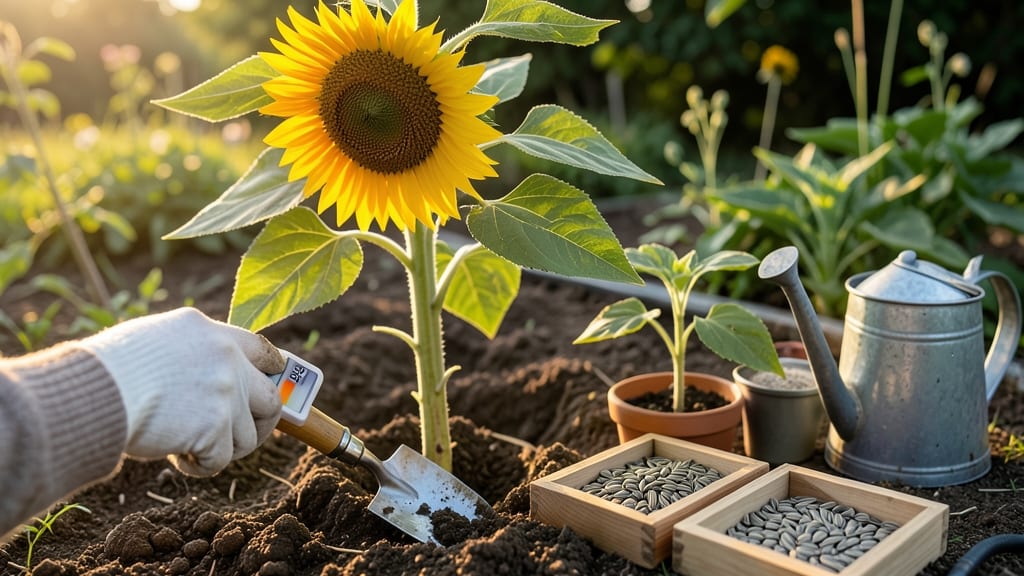
Sunflower soil requirements call for loose, nutrient-rich loam or sandy loam with a balanced pH of 6.0 to 7.5, packed with organic material and a depth of at least 18 inches to accommodate deep taproots and maximize growth potential.
Sunflowers thrive in soil that strikes the perfect balance between moisture retention and drainage—think of it as their golden ticket to success. 🌻 Loam-based soils (a mix of sand, silt, and clay) provide that ideal middle ground, while sandy loam prevents waterlogging that can drown roots.
The pH range isn't just a number—it ensures your plants can efficiently absorb essential nutrients like nitrogen and phosphorus, which fuel their rapid growth.
I've found that adding compost or well-rotted manure before planting gives sunflowers the extra boost they need, especially in heavier clay soils that might otherwise suffocate their roots.
💡 In This Article
- Why Loam and Sandy Loam Are Ideal for Sunflowers
- Preparing and Amending Soil for Sunflower Planting
Why loam and sandy loam are ideal for sunflowers
Sunflowers develop massive taproots that can reach depths of 4-6 feet to access water and nutrients, which is why soil texture plays such a critical role. Loam—composed of roughly 40% sand, 40% silt, and 20% clay—strikes the perfect balance by holding moisture while allowing excess water to drain away.
This prevents waterlogging, which can lead to root rot and stunted growth. The porous structure of loam also provides ample oxygen around roots, a vital factor since sunflowers require 1.5-2 gallons of water per week during their peak growing season.
The science behind this lies in soil particle composition. Sand particles (0.05-2mm) create air pockets that prevent compaction, while silt (0.002-0.05mm) holds moisture and nutrients near root zones. Clay (<0.002mm) binds organic matter but can become impermeable when saturated.
Sandy loam, with its higher sand content (50-60% sand), drains even faster, making it ideal for regions with heavy rainfall or poorly sloped gardens where water accumulation is a risk. 🌱 What most gardeners overlook is how this texture ratio directly impacts nutrient availability—sunflowers need consistent access to phosphorus for root development and potassium for flower formation.
Organic matter acts as the glue in this system, improving soil structure by binding particles together while also enhancing water retention. A well-amended loam can hold 20-30% more water than unamended soil, yet still drain effectively.
Think of compost or aged manure as tiny sponges that absorb and slowly release moisture, creating a reservoir for sunflowers' deep roots. Without this organic component, even the best-textured soil would quickly lose fertility as nutrients leach away during heavy watering or rainfall.
Here's what happens when soil composition goes wrong: Heavy clay soils (with >30% clay) become waterlogged and compacted, suffocating roots. Sandy soils (with >70% sand) drain too quickly, forcing sunflowers to expend energy seeking moisture rather than growing.
The ideal scenario is a loam that feels like a well-squeezed sponge—it holds moisture but doesn't stay soggy. You can test this by grabbing a handful: if it crumbles easily when dry and forms a loose ball when moist, you've got the right texture.
Consider this practical example: In my own garden trials, sunflowers planted in amended loam reached heights of 8-10 feet with sturdy stems, while those in unamended clay soil barely topped 5 feet and required staking.
The difference came down to root development—the loam plants had taproots 2 inches thick at the base, while clay-grown plants had shallow, brittle roots. This demonstrates why soil science isn't just theory—it's the foundation of sunflower success. 💫