
Shrubs
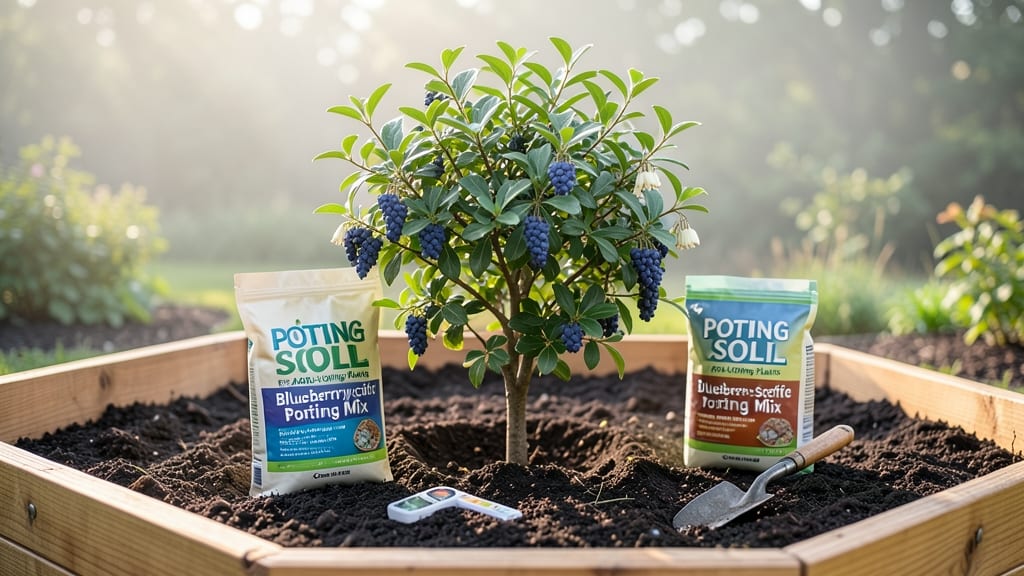
For potting soil for blueberry bushes, use an acidic blend with a pH of 4.5–5.5, mixing peat moss, pine bark, sand, and compost in a 3:2:1:1 ratio to ensure proper drainage and nutrient absorption for healthy growth.
Blueberry bushes thrive in acidic soil because their roots absorb nutrients like iron and manganese most efficiently at a pH of 4.5–5.5. 🌱 Without this acidity, your plants may struggle to uptake essential minerals, leading to yellow leaves or poor fruit production.
The 3:2:1:1 mix balances moisture retention (peat moss) with aeration (sand), while pine bark adds organic structure that breaks down slowly. Many gardeners swear by adding a handful of sulfur to adjust pH if their tap water is alkaline—just test your mix first!
Containers add another layer of complexity since they dry out faster than in-ground soil. If you notice yellowing leaves, it could signal overwatering or a pH drift—amend with pine fines or lemon juice (diluted) to restore acidity.
For 5-gallon pots, I recommend doubling the mix to ensure roots have enough space to establish before fruiting begins.
💡 In This Article
- Why Blueberry Bushes Need Acidic Potting Soil
- DIY Blueberry Soil Mix Recipes for Containers
Why blueberry bushes need acidic potting soil
Blueberry bushes have evolved to thrive in acidic environments because their root systems rely on specific nutrients that become unavailable in neutral or alkaline soils.
At a pH above 5.5, essential micronutrients like iron and manganese—crucial for chlorophyll production and fruit development—bind tightly to soil particles, making them inaccessible to roots. This is why you'll often see yellowing leaves (chlorosis) even when the plant appears healthy above ground.
The science gets even more interesting when you consider aluminum toxicity: in alkaline soils, aluminum becomes soluble and toxic to blueberry roots, while in acidic conditions (pH 5.5), it remains locked away harmlessly.
The organic components in your soil mix play a direct role in maintaining this acidity. Peat moss, for example, has a natural pH of 3.5–4.5 and breaks down slowly to release organic acids that gradually lower the pH of the mix.
Pine bark fines contribute both structure and acidity, releasing tannins that further acidify the soil over time. 🌿 What's fascinating is how these materials work synergistically: the coarse texture of pine bark creates air pockets for roots, while the fibrous peat moss holds moisture without suffocating roots—a perfect balance for container gardening where drainage is critical to prevent root rot.
Drainage isn't just about preventing soggy roots—it's about oxygen. Blueberry roots need constant access to oxygen to absorb nutrients efficiently. The 1:1 ratio of sand to organic matter in your mix creates this ideal porosity.
When I test my mixes, I always do the "squeeze test": if water drips freely after 10 minutes of saturation, the blend is properly aerated.
The worst mistake I've seen gardeners make is using garden soil or potting mixes designed for vegetables, which are often too alkaline (pH 6.5–7.5) and compacted, leading to stunted growth and poor fruiting.
Here's what happens when you get the acidity wrong: at pH 6.0, blueberries may produce small, tart berries with poor color development. Below 4.0, however, you risk aluminum toxicity again, even though the soil is acidic.
The sweet spot of 4.5–5.5 is where nutrient availability and root health align perfectly. 🔬 Professional growers use soil tests with meters that measure both pH and electrical conductivity (EC) to fine-tune mixes—you can get similar results with home test kits that cost around $20 and take just 5 minutes per test.
One surprising fact about blueberry soil chemistry is how temperature affects pH. In hotter climates, organic matter breaks down faster, potentially raising pH over time. That's why I recommend adding elemental sulfur (1/4 cup per 5-gallon pot) every 6–12 months to maintain acidity.
The sulfur oxidizes slowly, releasing acid that mimics the natural conditions blueberries evolved in. For visual learners, think of it like this: your blueberry's roots are constantly "shopping" for nutrients in the soil solution, and at the right pH, the store is fully stocked with everything they need.
For container growers, the soil volume matters tremendously. A 5-gallon pot provides about 1 cubic foot of growing space, which is enough for one bush but requires careful monitoring.
The root zone in containers heats up faster than in-ground soil, accelerating microbial activity that can raise pH. That's why I always recommend using 10% less peat moss in summer mixes—it retains too much moisture and can lead to fungal issues.
Instead, boost the pine bark proportion to 40% for better heat tolerance and drainage.