
Landscaping
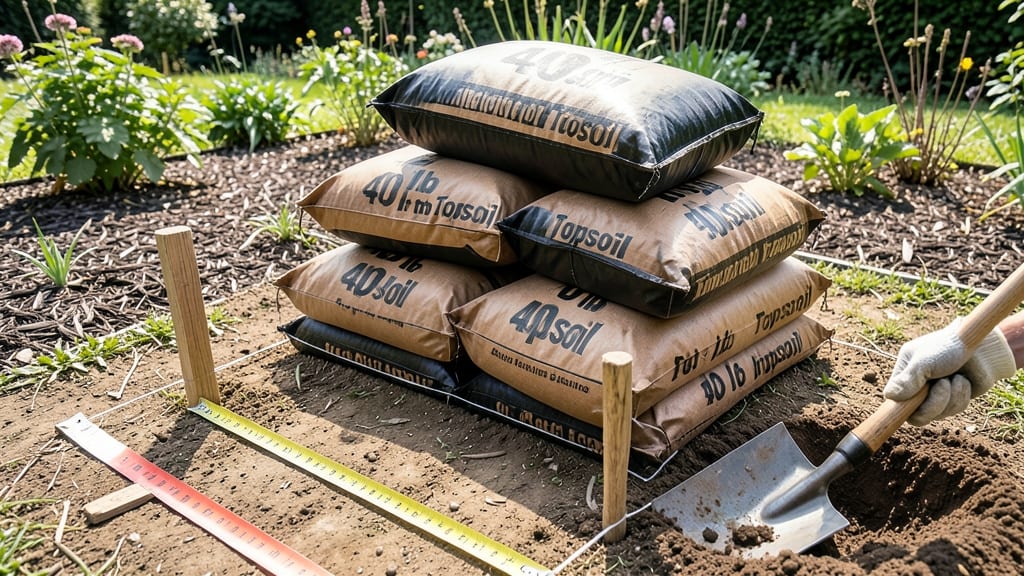
To determine how many 40lb bags of topsoil cover a yard, calculate based on depth: a 1-inch layer needs about 90 bags per 100 sq ft, while 2 inches requires 180 bags. For a full yard (e.g., 5,000 sq ft), multiply by depth—2 inches needs 900 bags. Always check bag density since brands vary.
Figuring out how many 40lb bags of topsoil you need depends entirely on your project's depth and area.
A 1-inch layer is standard for seed germination, but deeper layers (like 3-4 inches for new lawns) will require significantly more bags. 🌱 For example, a 500 sq ft garden needing 3 inches of topsoil would need around 450 bags—nearly double what a 1-inch layer would require.
Always account for settling and compaction, which can reduce effective depth by 10-20% after spreading.
Most topsoil bags weigh 40 lbs, but their volume varies—some brands pack more densely than others.
A cubic yard (27 cubic feet) typically contains about 1,000-1,350 lbs, meaning you'd need roughly 25-34 bags per cubic yard. Pro tip: If your yard has slopes or uneven terrain, add an extra 10-15% to your total to ensure full coverage.
💡 In This Article
- Topsoil Volume Math: Cubic Feet vs Bags
- Topsoil Coverage Calculator for Gardens and Lawns
Topsoil volume math: cubic feet vs bags
The conversion between topsoil volume and bag counts starts with understanding cubic feet. One cubic yard equals 27 cubic feet, and most topsoil weighs between 2,000-2,500 lbs per cubic yard—meaning a 40lb bag roughly equals 1.6-2 cubic feet of soil.
This variance comes from how densely the soil is packed, with loose, airy topsoil occupying more space than compacted varieties. For example, a 1-inch layer over 100 sq ft equals 6.94 cubic feet, requiring about 90 bags if using the lighter end of the density spectrum.
Depth directly impacts how many bags you'll need because volume scales with the cube of the measurement. A 2-inch layer doubles the cubic feet (now 13.89 cubic feet), so you'd need ~180 bags for the same area.
This is why landscapers often recommend 2-3 inches for new lawns—it provides enough depth for root systems while preventing erosion. However, if you're amending existing soil, a 1-inch layer may suffice, cutting your bag count in half.
Bulk density—the weight per cubic foot—varies by soil composition. Sandy soils are lighter (~100 lbs per cubic foot), while clay-heavy mixes can exceed 130 lbs.
This means a 40lb bag of sandy topsoil might occupy ~3.5 cubic feet, while clay-based soil could only fill ~2.5 cubic feet. Always check the manufacturer's specs, as some bags are labeled "lightweight" or "heavyweight" to reflect these differences.
Compaction plays a sneaky role too. Freshly spread topsoil settles 10-20% after watering or foot traffic, reducing effective depth. For instance, a 3-inch layer might shrink to 2.4 inches after settling, meaning you'll need ~20% more bags than your initial calculation.
This is especially critical for sloped areas, where erosion can further thin the layer.
Here’s a quick reference for common depths and coverage:
- 1-inch layer: ~90 bags per 100 sq ft (6.94 cubic feet)
- 2-inch layer: ~180 bags per 100 sq ft (13.89 cubic feet)
- 3-inch layer: ~270 bags per 100 sq ft (20.83 cubic feet)
- 4-inch layer: ~360 bags per 100 sq ft (27.78 cubic feet)
For a 5,000 sq ft yard, a 2-inch layer would need ~900 bags, but if you account for 15% settling, you’d want ~1,035 bags to ensure full coverage. Always round up—you don’t want to run out mid-project! 🌱