
How To
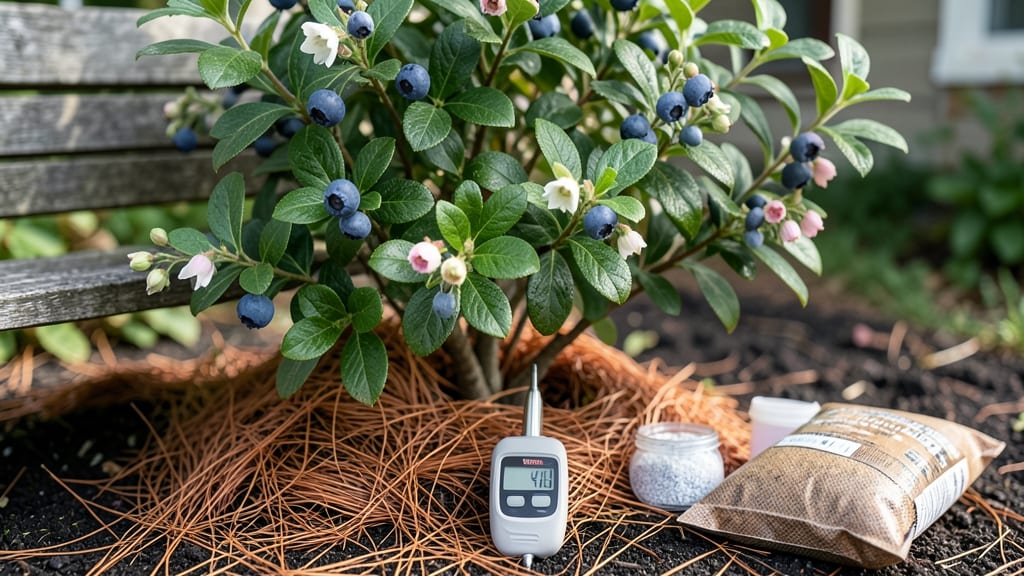
Blueberries need acidic soil with a pH between 4.5 and 5.5 to grow strong roots and produce sweet berries. Test your soil regularly and adjust with sulfur or peat moss if the pH climbs above 6.0.
Blueberries evolved in acidic wetlands, so their roots struggle when soil pH rises above 6.0. 🌱 At higher pH levels, aluminum and manganese become toxic, while essential nutrients like phosphorus and iron lock up—even if they're present in the soil.
I've seen gardens where blueberry bushes produced tiny, sour berries because the pH was slightly off; once we fixed the soil acidity, the plants thrived within a single season. Organic amendments like pine needles or coffee grounds work slowly but safely, while sulfur provides faster results for urgent corrections.
For best results, test soil every 2-3 years using a simple home kit or send samples to a lab for precise readings. Sandy soils acidify faster than clay, so they need more frequent adjustments.
Always work amendments into the top 6-8 inches of soil where roots actively grow, and water thoroughly afterward to activate the changes.
💡 In This Article
- How Soil pH Affects Blueberry Root Health and Nutrient Uptake
- Step-by-Step Soil Acidification Guide for Blueberry Gardens
How soil pH affects blueberry root health and nutrient uptake
Blueberries evolved in acidic bogs where the pH naturally hovers around 4.5 to 5.5, and their root systems are finely tuned to thrive in these conditions. At higher pH levels (above 6.0), aluminum and manganese—normally locked away in soil minerals—become soluble and toxic to blueberry roots.
These metals disrupt cellular functions, causing brown, stunted roots that can't absorb water or nutrients efficiently. 🔥 The roots also release organic acids to maintain their acidic rhizosphere, but this process becomes overwhelmed when soil pH climbs too high.
Nutrient availability shifts dramatically with pH changes. Phosphorus, a critical nutrient for blueberry growth, becomes less accessible above pH 6.5 because it binds tightly to soil particles.
Iron and zinc—essential for chlorophyll production and enzyme activity—also lock up in alkaline conditions, leading to yellowing leaves (chlorosis) even when the soil contains ample nutrients.
What's fascinating is how blueberries adapt: their roots grow more fibrous and shallow in acidic soils, maximizing surface area for nutrient absorption in the topsoil where pH is most stable.
Micronutrients like boron and manganese play starring roles in blueberry health, but their availability is pH-dependent. Boron, for example, becomes toxic at pH below 5.0, while manganese deficiency appears when pH exceeds 6.0.
This explains why blueberries in slightly acidic soil (5.0-5.5) often produce larger, sweeter berries—they're getting the perfect balance of these critical elements. I've noticed that bushes in pH 5.2-5.4 soil develop deeper purple foliage and thicker canes, signaling optimal micronutrient uptake.
The root zone's acidity also influences beneficial microbial activity. Mycorrhizal fungi, which form symbiotic relationships with blueberry roots, thrive in acidic conditions. These fungi help break down organic matter and make phosphorus more accessible, creating a feedback loop where healthy roots support better nutrient cycling.
Without this microbial partnership, blueberries struggle to access even abundant soil nutrients, regardless of fertilization efforts.
Visual clues can reveal pH-related stress. Leaves turning yellow between veins (interveinal chlorosis) is a classic sign of iron deficiency in alkaline soil, while stunted growth with small, hard berries often indicates manganese or zinc deficiency.
Even the berries themselves reflect soil health: those from acidic soil develop richer colors and sweeter flavors due to balanced sugar and acid production in the fruit. 💫 This is why gardeners obsessed with perfect blueberries obsess over pH testing—the roots' invisible world directly shapes what appears on the bush.
For those curious about the chemistry, blueberry roots maintain their ideal pH through proton (H+) excretion, a process that becomes energetically costly when soil pH rises. This is why bushes in marginal pH conditions (5.6-6.0) often look healthy but produce poor yields—they're working overtime just to survive.
The takeaway? Soil pH isn't just a number; it's the foundation of everything that happens below ground, where the magic of blueberry growth begins.