
Trees
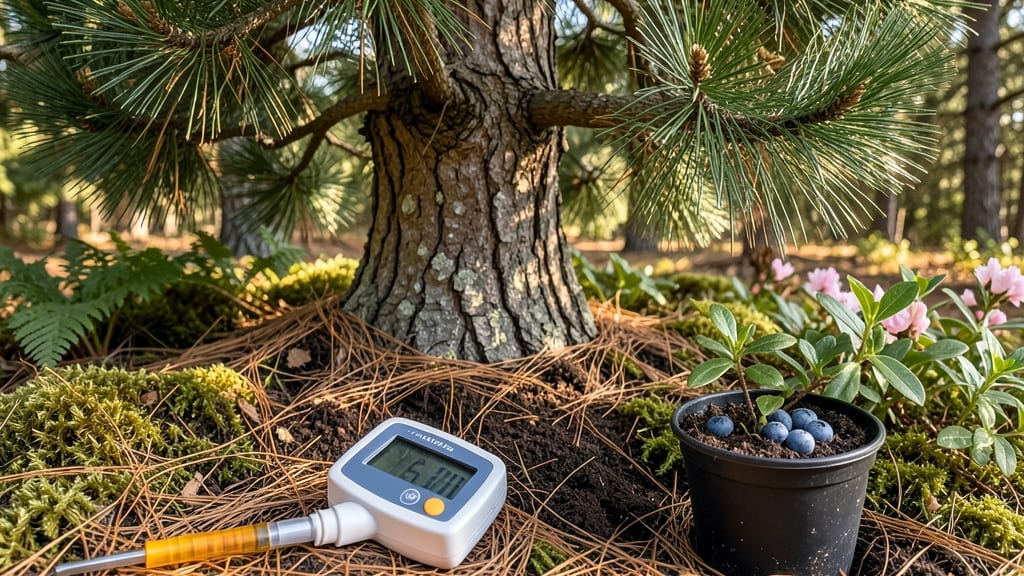
Pine trees do make soil acidic over time by releasing organic acids from decomposing needles, which lowers soil pH and creates conditions ideal for acid-loving plants like blueberries and rhododendrons.
This happens because pine needles contain high levels of tannins and resins, which break down into humic and fulvic acids as they decompose. 🌲 These compounds gradually acidify the soil, often dropping pH levels to 4.5–5.5—a perfect range for ericaceous plants.
The process accelerates in dense pine forests where fallen needles accumulate year-round, creating a natural mulch that continuously feeds the acidification cycle.
What's interesting is how this affects nearby plants. While acid-loving species thrive, many vegetables and flowers struggle in these conditions. Blueberries, for example, actually require this acidic environment to produce their signature tart flavor, but tomatoes or peppers would suffer without soil amendments like lime.
Gardeners often face this challenge when planting under mature pine trees, which is why soil testing becomes essential before attempting to grow non-acid-tolerant crops.
The acidification process isn't just about the needles—pine roots also release organic compounds that contribute to the effect. This dual mechanism explains why even young pine trees can start slowly altering soil chemistry over several years.
Understanding this natural process helps gardeners make informed decisions about companion planting and soil management strategies.
💡 In This Article
- How Pine Needles Acidify Soil Through Decomposition
- Managing Soil pH When Planting Near Pine Trees
How pine needles acidify soil through decomposition
When pine needles decompose, they release a cocktail of organic acids that gradually lower soil pH. The primary compounds involved are humic and fulvic acids, which form as microbial activity breaks down the complex organic matter in needles.
These acids are naturally acidic themselves, with pH values typically ranging from 3.0 to 5.0, and they bind to soil particles, displacing essential nutrients like calcium and magnesium while releasing hydrogen ions that further acidify the environment. 🌱
The process begins with the physical breakdown of needles, which can take 2-5 years depending on climate and moisture levels. In colder regions, decomposition slows dramatically, extending the acidification timeline.
Meanwhile, pine roots contribute additional organic compounds through a process called rhizodeposition, where roots exude carbon-rich substances that feed soil microbes—these microbes then produce more organic acids as a byproduct. This dual mechanism explains why even young pine stands can begin altering soil chemistry within 3-5 years.
The resulting soil typically reaches pH levels between 4.5 and 5.5, creating an environment ideal for ericaceous plants like blueberries, azaleas, and rhododendrons. These plants have evolved specialized root structures called mycorrhizal associations that help them absorb nutrients in acidic conditions.
The acidity also suppresses certain soil-borne pathogens, which is why pine forests often support diverse understory plant life despite nutrient-poor soils. 🌿
What's often overlooked is how the needle structure itself influences acidification. Pine needles have a thick, waxy cuticle that resists rapid decomposition, allowing acids to accumulate gradually over time. In contrast, deciduous leaves decompose much faster, releasing nutrients more quickly and having a less pronounced acidifying effect.
This structural difference explains why pine-dominated forests maintain consistently acidic soils even in nutrient-poor conditions.
The acidification process isn't uniform—it varies significantly by pine species. For example, loblolly pines produce more acidic litter than eastern white pines, with needle pH values differing by up to 0.5 units.
This variation means gardeners must consider both the pine species and local climate when assessing potential soil impacts. In coastal regions, where rainfall is high, acidification occurs more rapidly due to increased leaching of basic minerals from the soil. 💧
Interestingly, this natural acidification plays a crucial role in forest ecology. The acidic conditions help prevent the establishment of competing plant species, allowing pine trees to dominate ecosystems. This creates a feedback loop where pine trees maintain their own ideal growing conditions while suppressing other vegetation types.
Understanding this process helps explain why pine forests often appear so uniform in their understory composition.