
Advice
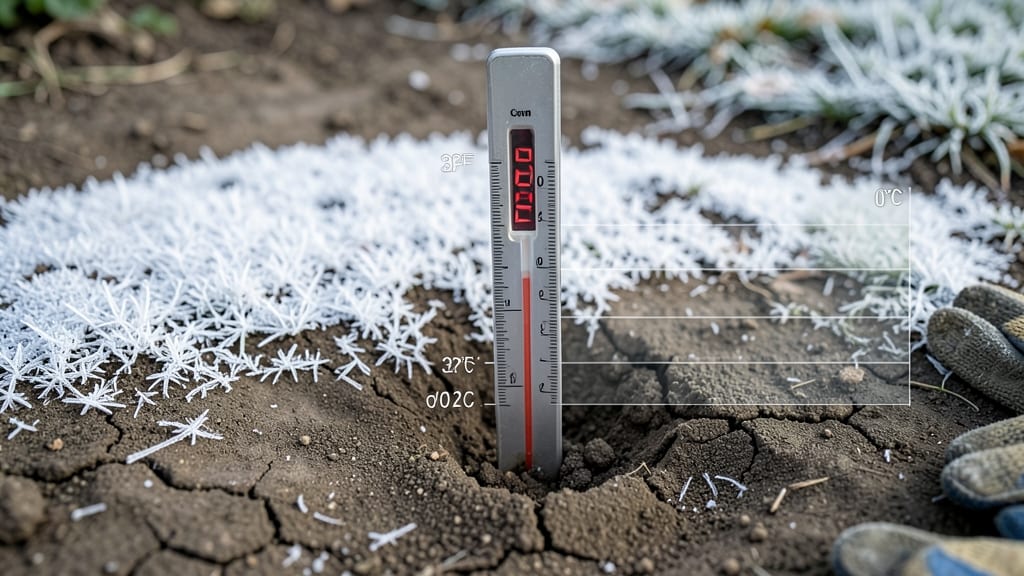
The temperature at which soil freezes typically ranges from 28°F (-2°C) to 32°F (0°C), influenced by moisture levels, soil composition, and your USDA hardiness zone. Sandy soils freeze more quickly than clay-heavy soils, while organic-rich soil can resist freezing longer. To safeguard plants, apply mulch or protective covers before hard freezes arrive.
Understanding soil freezing isn't just about the numbers—it's about how your garden's ecosystem reacts. 🌱 For example, in USDA Zone 5, where winter temps often dip below 20°F (-7°C), soil may freeze solid, while Zone 9 soils might only experience light frost.
The key difference? Moisture content acts like antifreeze—wet soil stays slightly warmer than dry soil. That's why clay holds moisture longer and resists freezing better than sandy soil, which drains quickly and drops below freezing faster.
But here's the real game-changer: organic matter in soil, like compost or decomposed leaves, creates tiny air pockets that insulate roots. This can raise the effective freezing point by 2-4°F (1-2°C).
That's why gardeners swear by thick mulch layers—it's not just decoration, it's a natural insulator that buys your plants precious time during early frosts.
💡 In This Article
- Soil Freezing Temperature by USDA Hardiness Zone
- Protecting Plants from Soil Freezing Damage
Soil freezing temperature by USDA hardiness Zone
Soil freezing isn't a one-size-fits-all number—it varies dramatically by location and soil type. In colder USDA Zones 3-5, where winter temperatures often plummet below 10°F (-12°C), soil can freeze solid down to 6-12 inches deep, especially in sandy or loamy soils.
The freezing point drops closer to 28°F (-2°C) in these zones because the ground loses heat rapidly through conduction. Meanwhile, in Zones 7-10, soil rarely freezes below 32°F (0°C)—light frosts may only chill the top 1-2 inches of soil.
The science behind this involves latent heat of fusion—water in soil releases heat as it crystallizes, creating a temporary buffer against freezing. Clay soils, which hold 30-50% more water than sandy soils, resist freezing longer because that extra moisture absorbs more heat energy during the phase change.
For example, a clay-heavy garden bed might stay above freezing until 26°F (-3°C), while nearby sandy patches could freeze at 30°F (-1°C). Organic matter compounds this effect by increasing soil porosity, which traps insulating air pockets.
Here's where things get interesting: soil temperature lags behind air temperature by 1-3 hours due to thermal mass. This means your thermometer might read 25°F (-4°C) at night, but the soil at 4-inch depth could still be 29°F (-2°C).
In Zone 6, where winters hover around 0°F (-18°C), this delay can mean the difference between a light frost (top 1 inch) and a deep freeze (6+ inches). That's why gardeners in transitional zones need to monitor soil temps—not just air temps—to protect shallow-rooted plants.
Consider this real-world example: In USDA Zone 4, where winter lows average -20°F (-29°C), a bare soil surface might freeze at 28°F (-2°C) but recover by midday when air temps rise.
However, the same soil covered with 3 inches of straw mulch could stay 5°F (3°C) warmer at the critical root zone. This 5°F difference can mean the difference between survival and damage for tender perennials like roses or peonies.
For precise planning, use a soil thermometer buried at 4-inch depth—the typical root zone for most annuals. In Zone 5, when air temps drop to 25°F (-4°C), check your soil thermometer: if it reads 29°F (-2°C), that's your warning to cover vulnerable plants.
The deeper the thermometer, the more insulated the reading, which explains why Zone 8 soils might only reach 30°F (-1°C) even during 20°F (-7°C) air freezes.
One counterintuitive fact: Wet soil freezes more slowly than dry soil because water's high specific heat capacity requires more energy to cool. That's why clay soils—naturally moisture-retentive—freeze at 2-4°F lower than sandy soils.
The trade-off? Once frozen, wet soil becomes denser and more conductive, potentially causing root damage during thaw cycles. 🌡️